
AI burnout can feel like constantly adapting, performing, and proving your value in a workplace where the rules keep changing faster than you can recover.
You are not behind. You are burned out.

You have learned the tools, sat through the trainings, adjusted your workflow, and figured out how to make AI fit into a job that was already demanding.
Then the tools changed again, with another platform being rolled out.
Then, another meeting appeared on your calendar about adoption, efficiency, automation, or staying ahead. Maybe your company introduced three new AI tools in the same quarter and expected everyone to adjust without any pushback.
Then maybe something even more frustrating happened: your manager started trusting an AI-generated report over the analysis you spent days building.
This is not the burnout that comes from working too hard for too long. This is something more specific. It is the exhaustion of being asked to constantly adapt, perform, and keep up with something that has no finish line, while still producing at the same level you always have.
For high achievers, leaders, founders, and professionals in demanding careers, AI is not just another tool. It can affect workload, identity, confidence, ethics, and the body.
AI burnout is not a formal clinical diagnosis. I am using the term to describe a real pattern of exhaustion, anxiety, ethical strain, and cognitive overload that many professionals are experiencing as AI changes their work.
Can AI pressure really cause burnout?
Yes, AI-related work pressure can contribute to burnout.
This is not the traditional burnout many people were taught to recognize. The type where you take on too much, push too hard, and eventually hit a wall.
AI burnout is more complicated.
Much of the exhaustion is cognitive. It can come from constant context switching, learning systems that keep changing, managing tools that are still new, and making important decisions while trying to keep up with an environment that has no clear endpoint.
There is also the gradual loss of the parts of work that once felt meaningful, especially for professionals who have spent years building expertise through school, training, mentorship, and years in the field. There can be real pride in solving problems, seeing nuance, and making thoughtful decisions.
When AI begins replacing the parts of work that once challenged you, the workload may not get lighter. The work may simply start to feel more hollow and less motivating.
In therapy, clients navigating AI-related stress often describe several things happening at once:
Overwhelm from new tools
Fear about job security
Ethical discomfort about what they are being asked to build or use
Frustration when leadership overtrusts AI
Fatigue that does not feel like regular tiredness
Isolation when they are deep in AI adoption work and friends or family have little to no experience with it
That combination can be hard to explain, especially when everyone around you is talking about AI like it is only exciting, efficient, and inevitable.
The workload nobody warned you about
AI is often marketed as a productivity solution. For many workers, though, it has become another layer of work on top of everything else.
There are new tools to learn, new procedures to follow, new expectations to meet, and new systems to monitor. All of this often happens without any real reduction in existing responsibilities.
Managers may overestimate how much time AI saves and underestimate how much mental energy it takes to use it well.
This creates workload creep: the gradual addition of AI-related tasks that are never fully counted in someone’s actual capacity.
Over time, that creep builds into cognitive fatigue. It can affect decision-making, patience, creativity, and the ability to do the deeper work high performers are actually hired to do.
The irony is hard to miss. The tool brought in to make work more efficient can make it harder to think clearly.
What happens when your judgment gets overridden by AI?
There is a specific kind of frustration that arises when your professional judgment is dismissed because an AI output appears more confident, cleaner, or more efficient.
For example, a project manager catches something important and flags it immediately. They use their experience, context, and judgment to explain why the issue matters. Instead of looking more closely at the project manager’s findings, the company chooses the AI output because it looks straightforward and polished.
But polished does not always mean accurate. Efficient-looking does not always mean correct.
AI systems are trained on existing data, which means they can inherit the blind spots, gaps, and assumptions built into that data. Real people are affected when inaccurate outputs are amplified without enough human review.
What can feel especially frustrating is that the employees dealing with the consequences may be the same ones who tried to flag the issue in the first place.
The emotional weight of this also depends on the industry and the stakes involved.
In some legal settings, the pressure may involve professional liability, with AI tools hallucinating, missing nuance, and producing confident but flawed output. When attorneys are expected to review, rely on, or sign off on AI-generated work product, the burden does not disappear just because a tool produced the first draft. They are still responsible for catching what the system may have missed.
In some healthcare settings, the concern is not just efficiency. It is whether the organization is prioritizing cost reduction over clinical accuracy. When providers are expected to defer to AI output that conflicts with their clinical judgment, they can be placed in direct conflict with their professional obligation to patients.
That is not ordinary burnout. It is a moral and ethical dilemma.
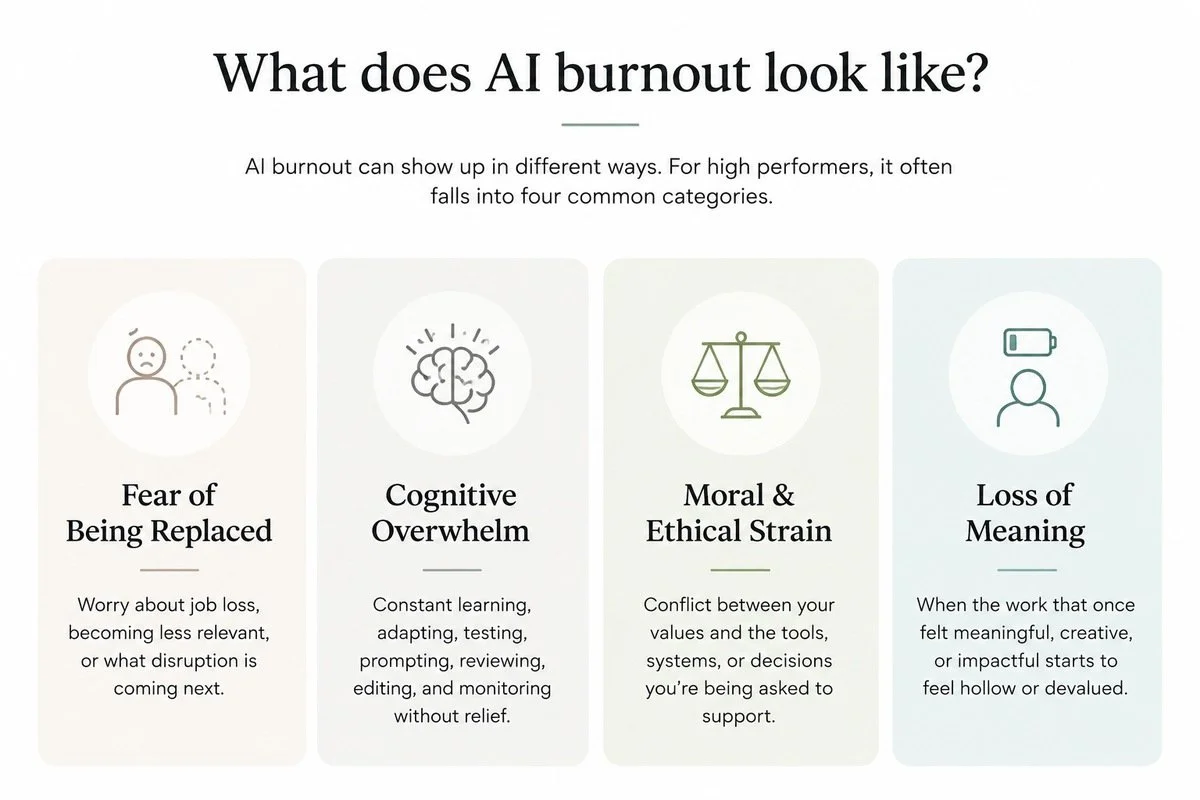
What does AI burnout look like?
AI burnout does not always look like collapse at first.
It may show up as overwhelm, irritability, numbness, dread, or the sense that everything feels chaotic but hard to explain.
For high performers, it often falls into a few common categories.
Fear of being replaced
This can include fear of job loss, fear of becoming less relevant, or fear of what disruption is coming next.
The question is not only, “Am I still needed?”
It becomes, “Will I still be needed?”
That kind of future-oriented fear can be draining, especially when layoffs, restructuring, and automation are already happening around you.
Cognitive Overwhelm
AI-heavy work can require constant learning, adapting, testing, prompting, reviewing, editing, and monitoring.
You may be expected to keep doing your full-time job while also becoming fluent in tools that keep changing.
That is a lot for the brain to hold.
Moral and Ethical Strain
Some professionals are being asked to use tools, build systems, or support changes that conflict with their values.
They may worry about accuracy, job displacement, bias, privacy, environmental impact, or whether the technology is being adopted responsibly.
For high achievers accustomed to being reliable, conscientious, and values-driven, this can create a painful internal conflict.
Do I speak up? Do I comply? Do I leave? Do I stay because I need the income?
None of these questions have simple answers.
Loss of Meaning
Another piece is the loss of meaningful work.
If the parts of your job that once made you feel capable, creative, useful, or respected are being automated or devalued, it can affect more than your schedule. It can affect your sense of identity.
For many high-achieving women, work is not just a role. It can become tied to worth, confidence, recognition, and the feeling of being enough.
If this pressure is bringing up self-doubt or the sense that you have to keep proving your value, imposter syndrome therapy may also be relevant.
So when AI starts doing parts of the work you spent years becoming good at, or when leadership trusts an AI-generated answer over your analysis, it can feel demoralizing.
It can bring up painful questions:
Was all of that effort worth it?
The late hours, the pressure, the missed time with friends and family, the years spent proving yourself?
That does not mean you are being dramatic. It means something important is shifting, and you are trying to make sense of what your work means now.
For women, there may be another layer. Many have already had to work harder to be taken seriously. Now, in some workplaces, they are not only pushing back against old power dynamics. They are also being asked to compete with tools that may not understand context, lived experience, bias, emotional nuance, or the kind of judgment that comes from years of doing the work.
That is a lot to navigate.
How does AI burnout show up in the body?
AI-related burnout is not only mental.
A person experiencing it may be sitting still all day, but internally, their system can feel like it is sprinting. Prompting, reviewing, switching tabs, checking outputs, scanning for errors, monitoring updates, and living in abstraction can keep the brain highly activated while the body gets ignored.
Over time, the body can start operating as if it is under chronic demand.
This may show up as:
Difficulty fully exhaling. A clenched jaw, tight shoulders, stomach tension, or pelvic floor tension. An internal buzzing feeling, even when exhausted. Trouble transitioning out of work mode. Difficulty eating, sleeping, stepping away from the screen, or noticing basic body cues. Feeling overstimulated and emotionally numb at the same time.
Many high-functioning women normalize this because they are still productive.
But productivity does not mean your nervous system is okay.
This is why some high achievers take time off and still do not feel rested. Their body may not have actually shifted out of a state of threat.
Part of the therapy work involves helping clients rebuild awareness of their internal cues. What does stress feel like before collapse? What does safety feel like in the body? What does enough feel like?
Grounding, breathwork, movement, sensory awareness, and nervous system regulation are not just wellness trends in this context. They are tools for helping a person return to their body after spending too much time in constant performance mode.
What actually helps with AI burnout?
The first step is naming what is happening.
Your exhaustion is not a personal failure. It is not proof that you are not adaptable enough. It is not a sign that everyone else is handling this better than you.
It may be a completely human response to an overwhelming environment.
That distinction matters because high performers often respond to burnout by pushing harder. Learn more. Stay later. Keep up. Prove you can handle it.
That response makes sense when fear is underneath it, but it usually worsens burnout.
In therapy, the work starts with understanding what is driving the exhaustion.
Is it the workload? Fear of replacement? Ethical discomfort? Identity loss? Being asked to ignore your own judgment? Feeling like the pace of change never stops?
Those require different responses.
From there, therapy may focus on:
Clarifying limits around overfunctioning
Communicating more honestly about capacity
Reestablishing trust in your own judgment
Separating your worth from performance and output
Regulating the body instead of trying to think your way out of every stress response
Creating limits around AI use, screen time, and work expectations
Reconnecting with identity outside of work
It also helps to separate what you can influence from what you cannot.
You may not be able to control your company’s AI roadmap, how much your manager trusts algorithmic output over human judgment, or the pace of change in your industry. Trying to mentally manage all of that is part of what becomes so draining.
The attention shifts to what you do have some say over: how you respond to the pressure, what you communicate about your capacity, where your limits need to be clearer, and what helps you feel like a person again.
FAQ: AI Burnout and High Performers
-
AI burnout is not a formal clinical diagnosis, but it describes a real pattern of workplace strain many professionals are experiencing. Burnout itself is classified by the World Health Organization as an occupational phenomenon resulting from chronic workplace stress that has not been successfully managed. [1] AI-related burnout can include cognitive exhaustion, pressure to keep up with rapid change, fear of job replacement, reduced meaningful work, ethical tension, and difficulty disconnecting from work.
-
Regular burnout is often connected to chronic workplace stress and workload. AI burnout can overlap with that, but the stressor is more specific. It may involve persistent adaptation, fear of becoming replaceable, ethical issues, loss of meaningful work, and pressure to prove your value in a changing workplace.
You can have a manageable workload on paper and still feel depleted by the uncertainty and disorientation AI is creating.
-
High performers are often trusted with complex work, change leadership, and important decisions. That means they may absorb more AI-related pressure than others.
When AI challenges your competence, relevance, values, and judgment all at once, the impact can feel much more personal.
-
Start by taking the pressure seriously instead of pushing through it.
Try to identify what is driving the exhaustion. Is it the workload? Fear of replacement? Ethical discomfort? Stress from constantly needing to adapt? Feeling like your expertise is being dismissed?
More effort is rarely the answer at this stage. Support can help you sort through what is happening and make decisions from a more grounded place.
If anxiety is a major part of what you are experiencing, online anxiety therapy can help you understand the fear, pressure, and constant mental scanning that may be keeping your nervous system activated.
Where to go from here
Your exhaustion makes sense.
You are having a human response to an environment that keeps asking more of you while offering very little stability in return.
Keeping up and burning out can happen at the same time. If you are managing the workload yet losing yourself in the process, doing more of the same is unlikely to help.
If burnout, AI-related stress, or work pressure is starting to affect your wellbeing, you can learn more about online burnout therapy for high-achieving women. If you are in Massachusetts, New York, Colorado, Vermont, or Florida and want to talk through what is going on, you can book a free consultation.
Related Reading
Burned Out or Depressed? How High-Achieving Women Can Tell the Difference
High-Functioning Anxiety: Practical Tools & Support
Founder Burnout & Imposter Syndrome: 2026 Guide
Research Note
AI burnout is not currently a formal clinical diagnosis. It is better understood as an emerging workplace stress pattern related to the rapid adoption of AI, shifting expectations around productivity, fear of replacement, ethical tension, and the pressure to keep adapting.
Research on AI-related workplace stress supports that this pattern is real. A 2025 study published in Acta Psychologica found that anxiety about job replacement and anxiety about learning AI were both linked with reduced work passion, with emotional exhaustion partially explaining that relationship. [2]A separate 2025 study published in Behavioral Sciences found that employees who perceived their job could be replaced by AI showed higher levels of emotional exhaustion, with job insecurity and work interference with family serving as contributing factors. [3]
What this means in practice: AI burnout should not be treated as a diagnosis. It is a way to name a pattern many professionals recognize. For high-achieving professionals, the strain may come from more than workload. It can also stem from constant adaptation, fear of being replaced, loss of meaning, ethical tension, and the pressure to prove continued value in a rapidly changing work environment.
Sources
-
World Health Organization. (n.d.). Burn-out an occupational phenomenon. Retrieved from https://www.who.int/standards/classifications/frequently-asked-questions/burn-out-an-occupational-phenomenon
-
Chen, X., Ke, J., Zhang, X. E., & Chen, J. (2025). The impact of AI anxiety on employees' work passion: A moderated mediated effect model. Acta Psychologica, 260, 105487. https://doi.org/10.1016/j.actpsy.2025.105487
-
Zheng, J., & Zhang, T. (2025). Association between AI awareness and emotional exhaustion: The serial mediation of job insecurity and work interference with family. Behavioral Sciences, 15(4), 401. https://www.mdpi.com/2076-328X/15/4/401
[ + ] Disclaimer: Educational Use Only & Crisis Support
Educational use only:
The information, tools, and/or tips in this article are for educational purposes only. They’re not a diagnosis, a treatment plan, or medical advice, and they don’t establish a therapist–client relationship. Everyone’s history and nervous system are different. What helps one person may not fit another. If mental health is disrupting your work, sleep, or relationships, talk with a licensed clinician in your state.
Crisis Support:
If you are having a mental health crisis, please call 988 (U.S.), your local emergency number, or go to the nearest emergency room.
