

Perfectionism Anxiety Loop: Signs and 3 Practical Shifts

The Perfectionism-Anxiety Loop is a cycle where pressure to perform creates overthinking, which only tightens your standards further. This guide breaks down how to spot it and 3 ways to shift it.
What you will learn:
Signs you’re stuck in the loop
Why self-criticism fuels anxiety
3 shifts you can try this week (with examples)
Why Perfectionism Can Fuel Anxiety
If you're a high-achieving woman juggling deadlines, expectations, and the quiet pressure to “have it all together,” you’re not alone. Many women who excel in their careers or academic lives also struggle privately with anxiety and often, perfectionism is the hidden root. In this post, you’ll learn how anxiety and perfectionism feed each other, plus a few practical shifts you can start using to change the pattern.
Perfectionism: The Hidden Driver of Anxiety
Perfectionism is never just about "doing well." It extends well beyond this and demands flawless execution. While perfectionism often looks like ambition or diligence, it can lead to:
Chronic Stress and Overwhelm
Fear of Failure or Rejection
Difficulty Celebrating Success
Procrastination or Burnout
In my work with female leaders, athletes, young professionals, women working in male-dominated industries, and with business owners, I often see perfectionism manifest as the inability to rest, harsh and unkind self-talk, or a constant fear of being "found out" as not good enough, despite impressive accomplishments.
Why It Can Hit High-Achieving Women Especially Hard
Perfectionism is often praised in our culture, especially in high-performing environments. But for women, it’s also tangled up in gendered expectations. For example, a woman should be hardworking and successful, yet she should never come off as overly confident or arrogant. A woman should be driven, but not "too driven." A woman should be competent, yet equally accommodating.
Now, add in societal messaging around appearance, parenting, relationships, and leadership. The pressure to excel in all areas can become overwhelming and suffocating.
Over time, these unrealistic standards create a feedback loop.
The Pattern Underneath: Self-Criticism
Perfectionism-driven anxiety is often amplified by self-critical thinking, not a lack of motivation. When the "inner critic” comes out, you don’t just want to do well. You feel like you have to do well to be okay. For a lot of high achievers, perfectionism started as protection. It helped you avoid criticism, stay in control, and feel safe. The problem is it eventually turns into a system powered by fear instead of values.
Research suggests self-compassion can ease the distress linked to maladaptive perfectionism, which can help loosen the anxiety cycle. This matters because perfectionism and anxiety often travel together. [1]
If perfectionism is part of your experience, that’s not a character flaw. It’s a learned strategy and it can shift.
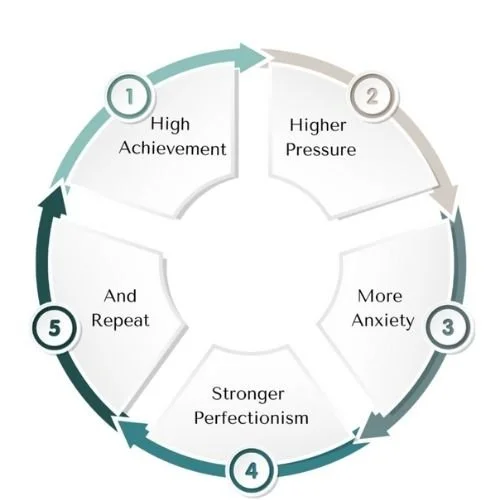
Anxiety-Perfectionism Feedback Loop
Signs You May Be Caught in the Perfectionism-Anxiety Loop
You replay conversations in your mind, worried you may have said the wrong thing.
You put off projects, fearing they won’t be “perfect enough.”
You feel like a failure when things don’t go exactly as planned.
You struggle to rest or slow down, even when exhausted.
You define your worth by what you do, not who you are.
If any of these sound familiar, you’re not broken. You’re stuck in a system that rewards pressure.
3 Small Changes That Reduce Perfectionism-Driven Anxiety
1. Reducing All-or-Nothing
Perfectionism often shows up as all-or-nothing thinking: If it’s not perfect, it’s a failure. Start by catching the extreme statement and rewriting it into something more realistic and usable. Aim for “accurate,” not “positive.”
Try this:
Extreme thought: If this isn’t perfect, it’s a disaster.
More accurate thought: I want this to be strong. It can be imperfect and still effective.
Next step: What’s the smallest action that moves this forward today?
2. Building a Self-Compassion Practice
Many high achievers are generous with others and brutal with themselves. Self-compassion is not lowering standards. It’s changing the tone of your inner voice so you can learn, adjust, and recover without shame.
Try this:
Ask: What would I say to someone I respect in this situation?
Say that to yourself in the same tone.
Add one truth: Two things can be true, I care about this, and I’m allowed to be human.
3. Redefining What Success Actually Means to You
Perfectionism thrives on external expectations and continuously moving the goal so that it feels impossible to achieve. The antidote is defining success in ways you can actually recognize and live. When you anchor success to values instead of approval, the pressure tends to soften.
Pick 2 values you want your life to reflect (example: health, connection, integrity, growth).
Define what “success” looks like this week that matches those values.
Choose one “enough for today” boundary so progress doesn’t turn into overwork.
Help That's Tailored to You
If you want support changing this pattern, you can book a free consultation.
If perfectionism is the main driver (inner critic, procrastination-paralysis, never feeling done), start here: Perfectionism Therapy.
If the pace of work and city life is part of what's keeping you in overdrive, you may prefer my specialized page on: Anxiety & Stress Therapy for Boston and NYC Professionals.
If you feel exhausted, checked out, or like rest never actually restores you, explore burnout therapy.
FAQs
Can perfectionism cause anxiety even if you are already successful?
Yes. Success doesn’t prevent anxiety when your internal voice creates rules that feel rigid and based on fear. Many successful, hardworking women feel anxious because mistakes are constantly perceived as high-stakes rather than normal human error that happens to everyone. One of the main drivers of anxiety is usually self-criticism, not a lack of ability.
What is the perfectionism-anxiety loop?
It’s a cycle where pressure to perform leads to overthinking and overworking. This cycle increases anxiety and tightens standards in unrealistic ways. You may get short-term relief after finishing a task, but the pressure typically returns shortly after. Over time, rest is perceived as “lazy” and can even feel unsafe. The idea of “good enough” is unattainable because the end goal keeps moving further and further away.
How do I know if I’m stuck in the perfectionism anxiety loop?
Common signs of the perfectionism anxiety loop include: replaying conversations in your mind, putting off tasks out of fear that they won’t be “perfect,” pressure to keep doing more even when exhausted, and basing worth on performance. You may also notice that you rarely feel satisfied, even after success, because you already feel pressure to start working towards the next milestone.
What are small changes that help with perfectionism-driven anxiety?
Start with three small, but helpful shifts. 1) Notice when your thinking is rigid instead of flexible. Try to find the middle ground (i.e., grey area). 2) Work on being kinder to yourself when things don't go “perfectly.” Try to measure success by what actually matters to you, and not by whether others approve. 3) Create an "enough for today" point. This can be helpful so you don't keep adding to your plate.
How do I stop overthinking mistakes at work?
Begin by identifying the fear behind your overthinking. For example, do you fear judgment from others, rejection, or losing credibility? Next, rephrase the thought into something more accurate, neutral, and helpful. Then, pick one small action to move forward. The good news is that overthinking often fades when you focus on solving the problem rather than proving yourself.
How to Get Unstuck When This Pattern Is Your Default

Perfectionism and anxiety can become deeply ingrained in day-to-day life, especially in high-performing environments. The goal isn’t to get rid of high standards. It’s to stop using fear, self-criticism, and overwork as the system that keeps you going. Small, consistent shifts add up.
If you want support applying these ideas to your specific patterns, you can learn more about working together here.
Related Reading
If you want a practical starting point for calming the pressure and overthinking, you may also like: High-Functioning Anxiety: Practical Tools & Support
If your self-worth is tied to performance, this can also help: Never Feel “Enough”? Self-Worth Strategies for High Achievers
[ + ] References: Perfectionism, Anxiety, and Self-Compassion
[1] Woodfin, V., Molde, H., Dundas, I., & Binder, P.-E. (2021). A randomized control trial of a brief self-compassion intervention for perfectionism, anxiety, depression, and body image. Frontiers in Psychology, 12, 751294. View Source
[ + ] Disclaimer: Educational Use Only & Crisis Support
Educational use only:
The information, tools, and/or tips in this article are for educational purposes only. They’re not a diagnosis, a treatment plan, or medical advice, and they don’t establish a therapist–client relationship. Everyone’s history and nervous system are different. What helps one person may not fit another. If mental health is disrupting your work, sleep, or relationships, talk with a licensed clinician in your state.
Crisis Support:
If you are having a mental health crisis, please call 988 (U.S.), your local emergency number, or go to the nearest emergency room.
